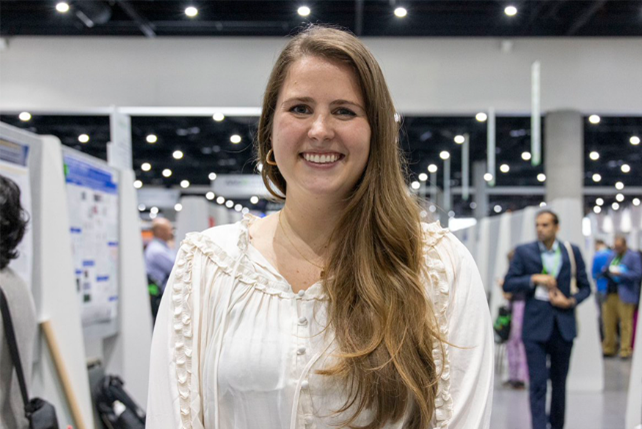
Polina Wright was awarded an AACR Scholar-in-Training Award for the 2025 AACR Special Conference in Pancreatic Cancer Research in Boston.
By Nayyerehalsadat (Nira) Hosseini
Department of CMGM, VCU School of Medicine
Email: hosseinin@vcu.edu
Date: 14th November 2025
Polina Wright, a G3 MD/PhD student in the Clinical and Translational Sciences program within the Wright Center for Clinical and Translational Research at the Office of Research and Innovation, has been selected to receive the AACR Scholar-in-Training Award. This competitive recognition, supported by the American Association for Cancer Research (AACR), enables her attendance at the AACR Special Conference on Advances in Pancreatic Cancer Research in Boston this September. Polina is currently an ITCB T32 Predoctoral Fellow, reflecting her growing role in translational cancer research.
Working under the mentorship of Dr. Azeddine Atfi, formerly of VCU’s CMGM department and now Deputy Director of the Karmanos Cancer Institute at Wayne State University, Polina’s research investigates the oncogenic role of tissue transglutaminase 2 (TGM2) in pancreatic ductal adenocarcinoma (PDAC) initiation and progression. She is currently conducting her experiments in Dr. Sarah Spiegel’s lab at VCU.
Polina’s study focuses on revealing how PDAC, one of the most lethal cancers, develops and progresses. Her team found that TGM2 plays a critical role in tumor initiation and is regulated by TGF-β signaling. Through genetically engineered mouse models and cell-based systems, they demonstrated that deleting TGM2 in oncogenic Kras models protects mice from developing pancreatic tumors. Interestingly, in models with concurrent Trp53 loss, TGM2 deletion did not completely protect against cancer progression, but modestly prolonged survival. These findings highlight TGM2 as a potential therapeutic target for early intervention and disease modulation, providing new insight into PDAC pathogenesis.
When asked what inspired her to pursue research alongside her medical degree, Polina shared, “I’ve always been drawn to asking scientific questions and exploring them hands-on in the lab. Pursuing a PhD alongside my medical training felt like a natural next step. My goal has been to learn how to translate those discoveries into improved outcomes for cancer patients.”
Encouraged by her mentor to apply for the AACR award, Polina reflected that the process was as meaningful as the recognition itself. “It pushed me to think deeply about my career goals and articulate my passion for research and medicine. It helped me reconnect my daily work in the lab to the larger purpose that drives me.” A manuscript based on her AACR-supported project is currently in preparation, with exciting findings to be shared soon.
Beyond the bench, Polina is passionate about mentoring high school and undergraduate trainees through cancer education and research initiatives. “Helping others find their own path in science is incredibly rewarding,” she said. Outside academia, she enjoys traveling, spending time with her son, and running a luxury picnic and charcuterie business, which she says allows her to think creatively and reminds her that creativity, service, patience, and compassion play pivotal roles in medicine.
Reflecting on her experience, Polina offered advice to future students: “Seek out opportunities early and take time to reflect on your career goals, not just to prepare for awards like this, but to stay connected to the purpose and passion that drive your work.”